


Intro
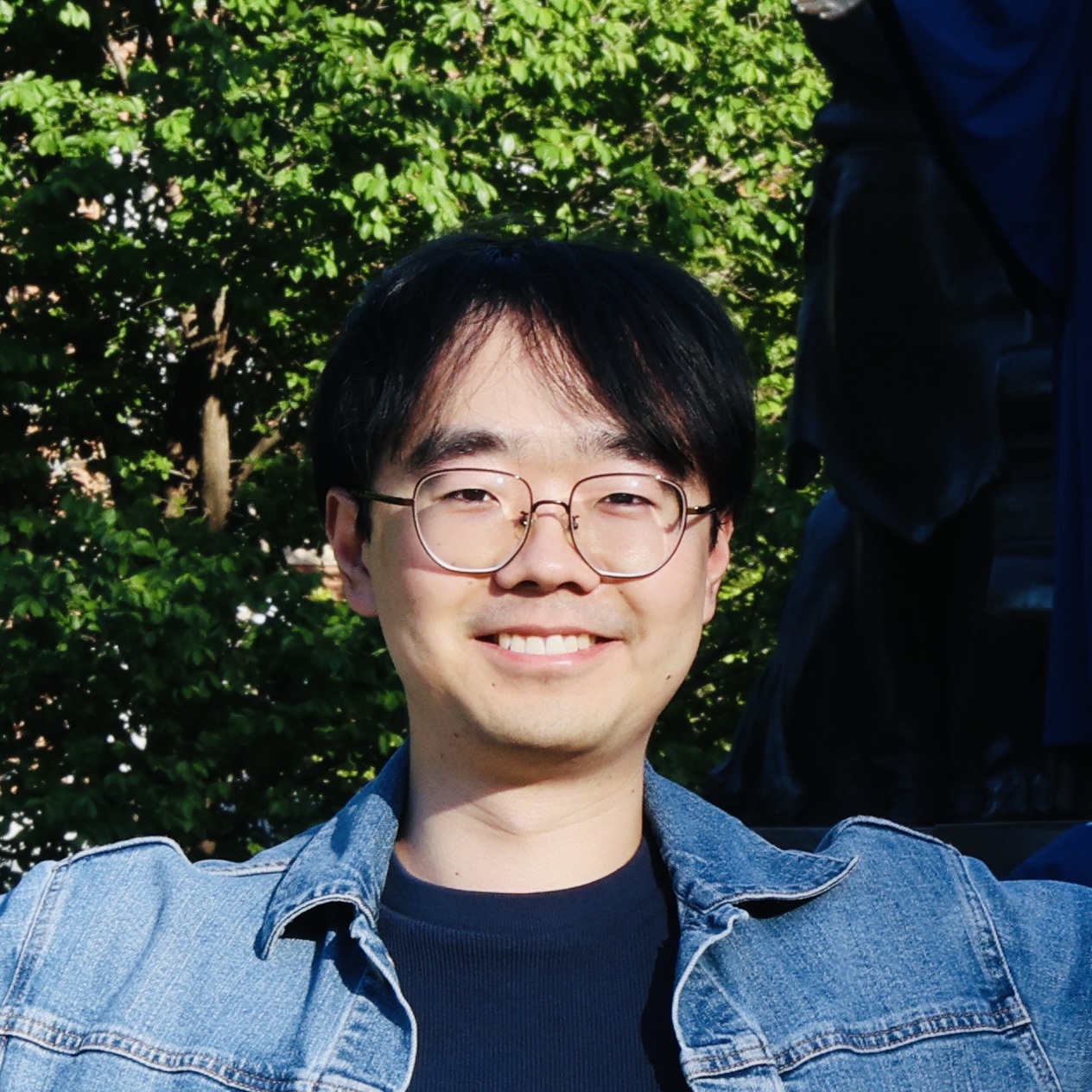
I am currently a PhD student in Data Science at College of William & Mary under the supervision of Professor Qingyun Wang. I earned my master's degree in Computer Science at University of Illinois at Urbana-Champaign (UIUC) supervised by Professor Gokhan Tur and Professor Dilek Hakkani-Tür, and my bachelor's degree in Computer Science with Mathematics minor at New York University Shanghai supervised by Professor Yik-Cheung (Wilson) Tam.
At New York University Shanghai, I received Dean's Undergraduate Research Fund (DURF) and conducted research on neural symbolic methods for boosting large language models' reasoning ability and investigated the advantage of using Prolog language (a logic programming langauge) as the generation output in terms of data augmentation for finetunining. After that, I explored how large language models could be used to solve dialogue state tracking, which is a key component in task-oriented dialogues, and witnessed a major improvement compared with previous methods.
At University of Illinois at Urbana-Champaign, I joined ConvAI Lab and worked on conversational AI and agentic systems. I explored how benign friction in conversation helps conversational AI better assist users. After that, I was particularly interested in multi-agent systems (MAS). I participated in benchmarking MAS covering a comprehensive range of tasks and also proposed a novel method called Gradient-Based Connections (GBC) to optimize the prompts of multi-agent systems, which significantly improved the performance of the system in conversational scenarios. Meanwhile, I participated in CELaRAI project, where I developed a system to help early literacy education for children using large language models.
News
Selected Publication
GBC: Gradient-Based Connections for Optimizing Multi-Agent Systems
Proceedings of the 27th Annual Meeting of the Special Interest Group on Discourse and Dialogue, 2026
PredAct-Bench: Benchmarking Tool-Augmented Dialogue under Controlled Tool Noise
arXiv, 2026
PlanBench-XL: Evaluating Long-Horizon Planning of LLM Tool-Use Agents in Large-Scale Tool Ecosystems
arXiv, 2026
Goal Alignment in LLM-Based User Simulators for Conversational AI
Transactions of the Association for Computational Linguistics, 2026
Must Read: A Comprehensive Survey of Computational Persuasion
ACM Comput. Surv., 2026
Question Generation for Assessing Early Literacy Reading Comprehension
10th Workshop on Speech and Language Technology in Education (SLaTE), 2025
MultiAgentBench : Evaluating the Collaboration and Competition of LLM agents
Co-first author
Proceedings of the 63rd Annual Meeting of the Association for Computational Linguistics (Volume 1: Long Papers), 2025
EscapeBench: Towards Advancing Creative Intelligence of Language Model Agents
Proceedings of the 63rd Annual Meeting of the Association for Computational Linguistics (Volume 1: Long Papers), 2025
ReSpAct: Harmonizing Reasoning, Speaking, and Acting Towards Building Large Language Model-Based Conversational AI Agents
Proceedings of the 15th International Workshop on Spoken Dialogue Systems Technology, 2025
Arithmetic Reasoning with LLM: Prolog Generation & Permutation
Proceedings of the 2024 Conference of the North American Chapter of the Association for Computational Linguistics: Human Language Technologies (Volume 2: Short Papers), 2024
Opensource Project
AgentChord
AgentChord is a flexible framework for designing, running, and optimizing multi-agent systems. It introduces Gradient-Based Connections (GBC) for automated MAS optimization, provides visualization tools for analyzing the optimization process, integrates with Weights & Biases for experiment tracking, and builds on LiteLLM to support model APIs from multiple providers.
MARBLE
Multi-Agent CooRdination Backbone with LLM Engine (MARBLE) is a modular and extensible framework for developing, testing, and evaluating LLM-based multi-agent systems. It provides structured simulated environments where agents can communicate, reason, and coordinate to complete tasks collaboratively or competitively.
Misc
Hearthstone
Outside research, I have also spent time in competitive gaming. One of my favorite memories is reaching No. 18 on the Hearthstone Americas server, which taught me a lot about strategy, decision-making under uncertainty, and adapting to changing metagames.

Tennis
I trained in tennis for three years in high school and still remain impressively bad at it. I do enjoy the sport, though — unfortunately, athletic talent has never been my strongest feature. 🥹